Design, Cabling, Splicing, OTDR testing and Fault finding – Fibre Optic
If your looking to:
- Improve your internal network speed
- Improve network efficiency
- Transmit information over 90m without loss
- Survey your existing network
- Identify any damage to existing installation (ODTR TESTING)
- Re-splice damaged connections
- Install an entirely new network
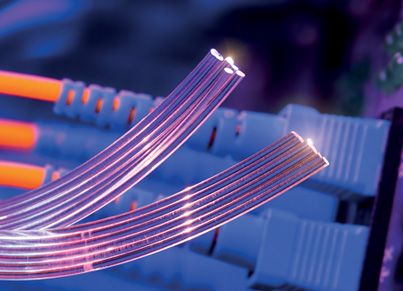
Then call us today and we can discuss your needs and the next steps to improve your network. | 0800 161 3440
NetworkFibre optic solutions will involve a full assessment of your data needs, taking into account the scale and design of your physical infrastructure.
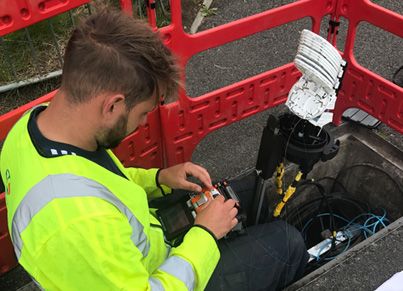
We have experience in both single and multimode fibre and we are able to manage your installation from design to final testing. Our team will take a comprehensive assessment of your existing ducting and baskets to determine if they are suitable for fibre Optics and can advise and plan any additional ducting that is needed. We then install, splice, terminate and test our systems. Through our meticulous preparation and professional installations we ensure low downtimes and high availability to our customers.
Want to know more about our services?
Single and Multimode Fibre
Quality Service
- All fibre optic cables are terminated with fusion splicers to give the best possible connection
- Fibre optic patch panels and boxes can be presented with any of the standard connector end Types, i.e. ST, SC, LC, MTRJ
- All connections are tested using optical power and light source meters
- All installations receive an ODTR report FREE of Charge as a digital file or print charge.
- Customers are supported and advised to ensure you get the best out of your Fibre Optic network
Single Mode
Single Mode cable is a single stand of glass fibre with a diameter of 8.3 to 10 microns. (One micron is 1/250th the width of a human hair.) Single-mode fibre gives you a higher transmission rate and up to 50 times more distance than multimode, however it also costs more as does the associated equipment.
Multimode
Multimode cable is made of multiple strands of glass fibres, with a combined diameter in the 50-to-100 micron range. Each fibre in a multimode cable is capable of carrying a different signal independent from those on the other fibres in the cable bundle. POF is a newer plastic-based cable which promises performance similar to single mode cable, but at a lower cost.
What is the difference?
What is the difference between multimode and single mode fibre? Multimode fibre has a relatively large light carrying core, usually 62.5 microns or larger in diameter. It is usually used for short distance transmissions with LED based fibre optic equipment (Which is cheaper). Single-mode fibre has a small light-carrying core of 8 to 10 microns in diameter. It is normally used for long distance transmissions with laser diode based fibre optic transmission equipment.
What should I install?
This all depends on the application. Multimode fibre will allow transmission distances of up to about 10 miles and will allow the use of relatively inexpensive fibre optic transmitters and receivers. There will be bandwidth limitations of a few hundred MHz per Km of length. Consequently, a 10 mile link will be limited to about 10 to 30 MHz. For CCTV this will be fine but for high speed data transmission it may not be.
Single-mode fibre on the other hand will be useful for distances well in excess of 10 miles but will require the use of single-mode transmitters (which normally use solid-state laser diodes). The higher cost of these optical emitters mean that single-mode equipment can be anywhere from 2 to 4 times as expensive as multimode equipment.
Depending on your needs you may want a full fibre network or you may just want a fibre link or backbone running into your existing copper network. What ever your need we can tailor a perfect solution for you.